Marlene Dumas in the Louvre
Dominic van den Boogerd
Liaisons is the name of a group of nine recent paintings by Marlene Dumas (b. 1953), which have been given a permanent home in the Louvre. The series clearly demonstrates how the work of this South African artist has undergone a remarkable development in recent years: a move away from painting to photographic imagery and away from a more or less realistic representation of the human figure. The paintings depict large, imposing heads, not of flesh-and-blood people, but of beings of unclear origin and indeterminate age, sometimes male, sometimes female, or somewhere in between. The faces are depicted frontally and fill the canvas, in large, vibrant planes of colour and a few confident lines. Standing face to face with Liaisons, we find ourselves in the company of spirits, gods and other immortals, whose powers are far beyond our understanding and imagination. The intense facial expressions elicit an involuntary shiver of holy reverence.
The paintings were commissioned by Laurence des Cars, the first female director of the Louvre, appointed in 2021 by President Macron. Des Cars won her spurs as an expert in nineteenth-century painting at the Musée d’Orsay. Her exhibition Le modèle noir de Géricault à Matisse (2018) received a lot of attention, with its focus on the representation of Black identity in French painting. This is not the first time the Louvre has invited a contemporary artist to create new work for the museum. Cy Twombly, Anselm Kiefer, François Morellet and Luc Tuymans have preceded Dumas. Tuymans’s 2024 mural was temporary. Kiefer’s enormous painting Athanor can be seen with two of his sculptures in the stairwell of the Department of Egyptian Antiquities. Cy Twombly’s ceiling painting in the Salle des Bronzes Antiques and François Morellet’s window installation in the Lefuel stairwell – both from 2010 – are, like the Liaisons by Dumas, permanent fixtures. This is, however, the first time a female artist has been selected for such a prestigious commission. Liaisons, now part of the Louvre’s collection, is a dream legacy for Des Cars.
The commission originated in the task Des Cars faced when she took office. The largest and busiest museum in the world is at risk of falling victim to its own popularity. Every day, twenty to thirty thousand people crowd around the Mona Lisa. Increasing flows of visitors are creating congestion in the cramped main entrance under the glass pyramid on the Cour Napoleon. The museum had to be made more accessible. To take pressure off the main entrance, a second entrance at the Porte des Lions at the western end of the Denon Wing has been renovated and expanded. The entrance now consists of a high-ceilinged atrium with an open staircase leading to the museum galleries on the first floor. There, in the recently refurbished Galerie des Cinq Continents, art from all periods and continents is on display, from Pre-Columbian pottery from Latin America and ritual objects from Africa to Phoenician death masks, Indian statues of gods and even a stone moʻai figure from Easter Island. The wall above the cloakrooms in the atrium, over ten metres wide and almost thirteen metres high, directly opposite the stairs, was earmarked for a work by Marlene Dumas.

oil on canvas, 9 parts, 175 x 163 cm each
photography: Nicolas Bousser
The artist was given free rein – inasmuch as a commission for a public state institution can ever be truly free. Initially, Dumas toyed with the idea of painting portraits of well-known and less well-known French cultural and media personalities. The museum reacted with scepticism. With portraits, the focus can quickly shift to the social position or significance of those depicted, and there is always a risk of controversy. So, no portraits. In a sense, this represented a liberation for Dumas from her usual way of working. She could now dedicate herself to something new, something that had already emerged in her exhibitions in London (Mourning Marsyas, 2024) and Athens (Cycladic Blues, 2025) and which reveals itself in full force in Paris.
A wall painting was not an option; Dumas thought the wall area was too large, and she also prefers work that is not tied to one location.
Originally, the entrance hall housed four nineteenth-century bas-reliefs by Louis-Denis Caillouette, dedicated to the Muses. Dumas decided to make paintings based on sculptures of human figures and chose to employ the same format as that of the reliefs, 175 by 163 centimetres, somewhat larger than she was used to. The allegorical tableaux have since been removed. The wall is now adorned by nine paintings of expressive heads, not neatly lined up, but loosely grouped in a way that suggests change and motion. If these figures have any kind of relationship with one another, they are undoubtedly fleeting and of a changing nature.
Most of the nine characters in Liaisons are related to the ancient heroes and barbaric demons in the Galerie des Cinq Continents. One of them has the same jet-black, almond-shaped eyes as the Egyptian queen whose image is in one of the display cases. Another head resembles the ancient figurine of a bulul, a tutelary deity of rice in the Philippines. Dumas has previously painted heads based on sculptures. Nervous, graffiti-like paintings such as Lady of Uruk and Nefertiti, both from 2020, were inspired by sculptures from antiquity. The Liaisons are, however, not faithful copies of pieces in the museum’s collection. Just as a DJ mixes samples of various origins, Dumas combines aspects of different sculptures here. For example, the exceptionally sensual lips of the girl in Split Stone (each of the nine Liaisons has its own title) reflect those of a figurine of a young Egyptian queen, possibly Kiya or Nefertiti, in the collection of the Metropolitan Museum of Art in New York, or rather: a fragment of her alabaster face. Differences in colour and texture on either side of a diagonal axis create the impression that the face painted by Dumas consists of two separate halves. Many sculptures that have been handed down through the centuries are damaged, incomplete, or have lost their original colours.
No two of these heads look alike. Each is unique, has a different kind of nose, a different kind of lips. Just as there is no scientific basis for dividing the human species into races and a strict gender-based division is at the very least questionable, Dumas avoids every form of classification and stereotyping. The facial expressions also vary. The ecstasy of St Theresa can be seen in the yearning gaze of Blue Bataille, as immortalised in marble by Lorenzo Bernini in the Santa Maria della Vittoria in Rome. Other faces appear to express feelings of fear or shock. The archetypal facial expressions are reminiscent of the caricatures of Honoré Daumier and the busts of Franz Xaver Messerschmidt: these are basic figures, which have taken on a digital form in the emojis that are used worldwide. The colour is the most distinctive feature. In each painting, one colour is dominant. The head in Bronze Moss is dark green, as if it has just emerged from a ditch full of duckweed. Other faces are predominantly sandy yellow, rusty brown, copper red, cobalt blue. Paradoxically, the mixed shades lend these divine apparitions a touch of materiality, something earthly, as if they were completely natural.
A precursor of this group of paintings is Nemesis (2024), the first work that Dumas painted based on a sculpture in the Louvre. The head is modelled on a shamanic mask from the northwestern coastal region of Canada. The somewhat childlike but commanding face, with its fleshy lips and spherical holes for eyes, was shown at the Mourning Marsyas exhibition in London last year. A little less than a year later, a second painting of the same theme was created, this time on a larger scale and, more importantly, painted in a completely different way. While Dumas consulted a photographic reproduction for Nemesis, with this painting she abandoned any such points of reference: Vermillion Heat, part of Liaisons, was not born from a drawing based on a photograph, but from a formless puddle of paint, from the material conditions of painting itself.
Dumas’s decision to paint in a large format for the Louvre commission played a role here, as did her move earlier this year to a second, much larger studio, just outside Amsterdam. This increase in scale meant that Dumas was faced with a conundrum: how to cover a vast surface with just one single gesture. She found a solution in pouring out a large quantity of highly diluted oil paint. During the process, the tightly stretched canvas lies flat on a low, mobile worktable, designed specially for this purpose, so that the painter can approach it from all sides. While working, Dumas constantly had to remind herself to prepare sufficient paint and to use larger mixing tanks. As a reminder, on the wall of her new workshop, there is a photograph of Willem de Kooning’s studio, where there were always large buckets of paint at the ready, waiting to be used.
Dumas has experimented with this technique before: The Origin of Painting (The Double Room) from 2018, is one of her first large-format paintings featuring spilled paint. Pouring the paint is a tense moment and difficult to control; the results are highly unpredictable. A coloured puddle forms, which remains on the canvas as a thin film. The paint does not penetrate the prepared canvas – this is where Dumas’s technique differs from Helen Frankenthaler’s famous ‘stains’. Sometimes the painter lifts the canvas a little to guide the flow of the paint. Occasionally she adds paint in a different colour, applies a few rudimentary wet-on-wet markings, or wipes or dabs off excess paint. As the paint dries, a gradual shift in colour saturation can occur, creating the suggestion of glowing light. It is as if this way of painting allows the paint to be more itself, to go its own way, to be less subject to the will of the painter.
You could describe Dumas’s way of working as a ‘haptic’ form of painting, based on the Greek word haptesthai, meaning ‘to touch’. Looking and feeling go hand in hand here. Seeing and touching complement each other. When the paint is dry and the canvas is upright against the wall, it is not yet clear what kind of head will emerge from the colour. The painter, as she indicated in a studio talk this summer, is ‘a bit afraid of that thing’; she does not want to ruin it and is keeping all options open for the time being. But just as strongly as the doubt, Dumas also feels the need and the responsibility to make decisions. On the canvas, indications of a pair of eyes, a chin, the underside of a nose appear – hints of what will inevitably lead to a human-like face.
Looking at these strange creatures hanging high on the huge wall, you sometimes get the uneasy feeling that they are looking back at you. The beady black eyes in Ceramic Silence, for example, stare at us from behind a shield of blue glaze, with the empty gaze of a wild animal. It is the same cold, indifferent expression as that of Saturn devouring his offspring, or Medusa turning all those who look at her into stone, as so masterfully depicted by Goya and Caravaggio. Somewhere, there is an invisible border between our world and the realm of the Liaisons, which seems grotesque and monstrous to us. A line we are afraid, unable and unwilling to cross.
How to describe this experience of our limits? You could see in the flowing features a reflection of a ‘disintegrating self’, once described by Lieven De Cauter, in a study of intoxication, as the ‘loosening of the self’ (Archeologie van de kick, 2009). In Dumas’s previous paintings of people in an apparent daze or state of inebriation, such as Smoke (2018) and Intoxication (2018), this ‘loosening self’ is translated into outlines that blur, into colours that run, into an impending disintegration of the image. Facial features slacken, soften, seem to dissolve into their surroundings. Diminishing self-control draws physical decline closer, just as sickness and pain are harbingers of inevitable death – our poor bodies are simply pre-programmed to stop living at some point. The dried patches of paint involuntarily bring to mind stains made by urine, blood, drool or other fluids which, once discharged from the body, are considered dirty and unpleasant. Fluidity, limitlessness and formlessness are barely kept in check in the Liaisons by lines and demarcation.
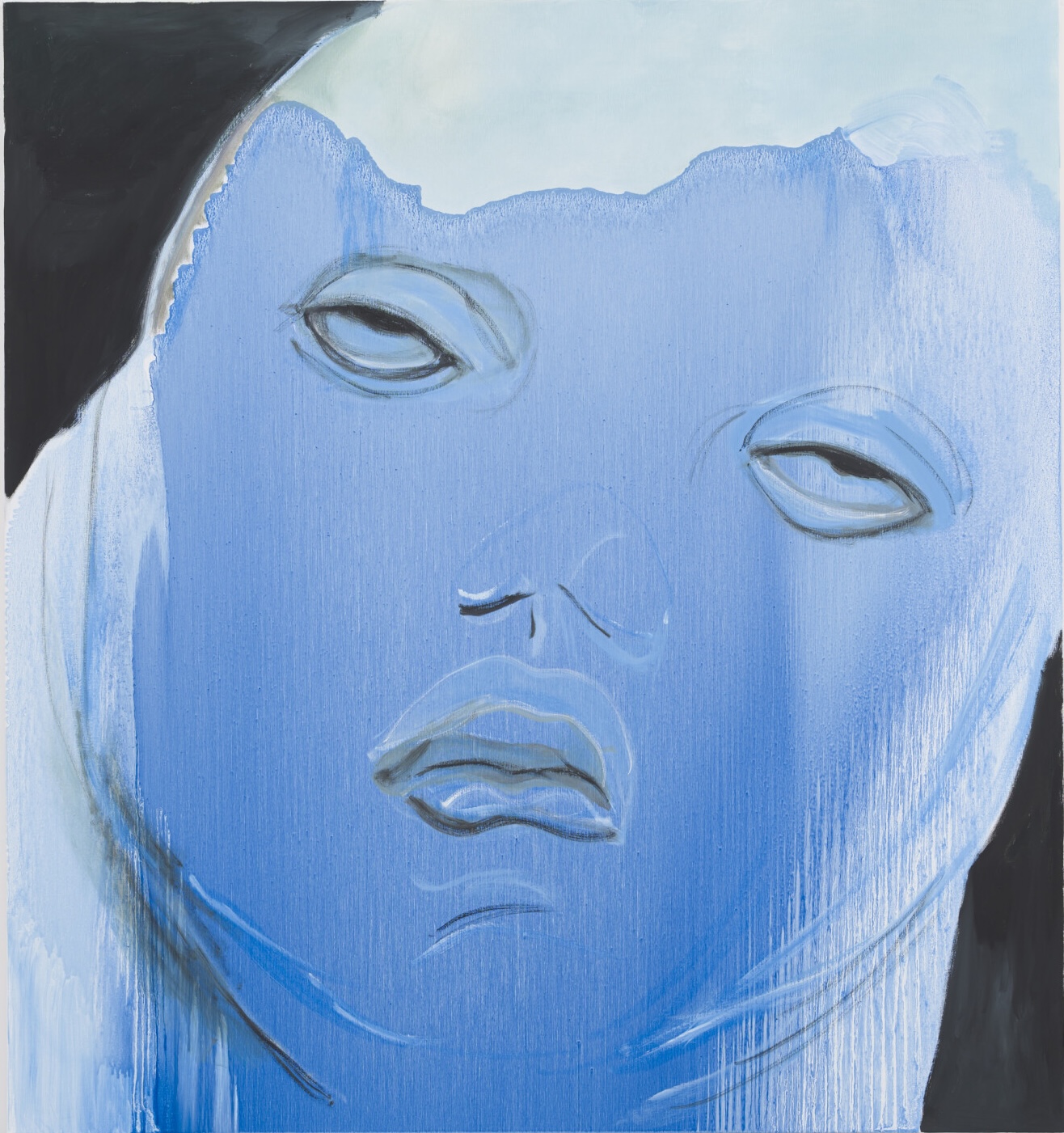

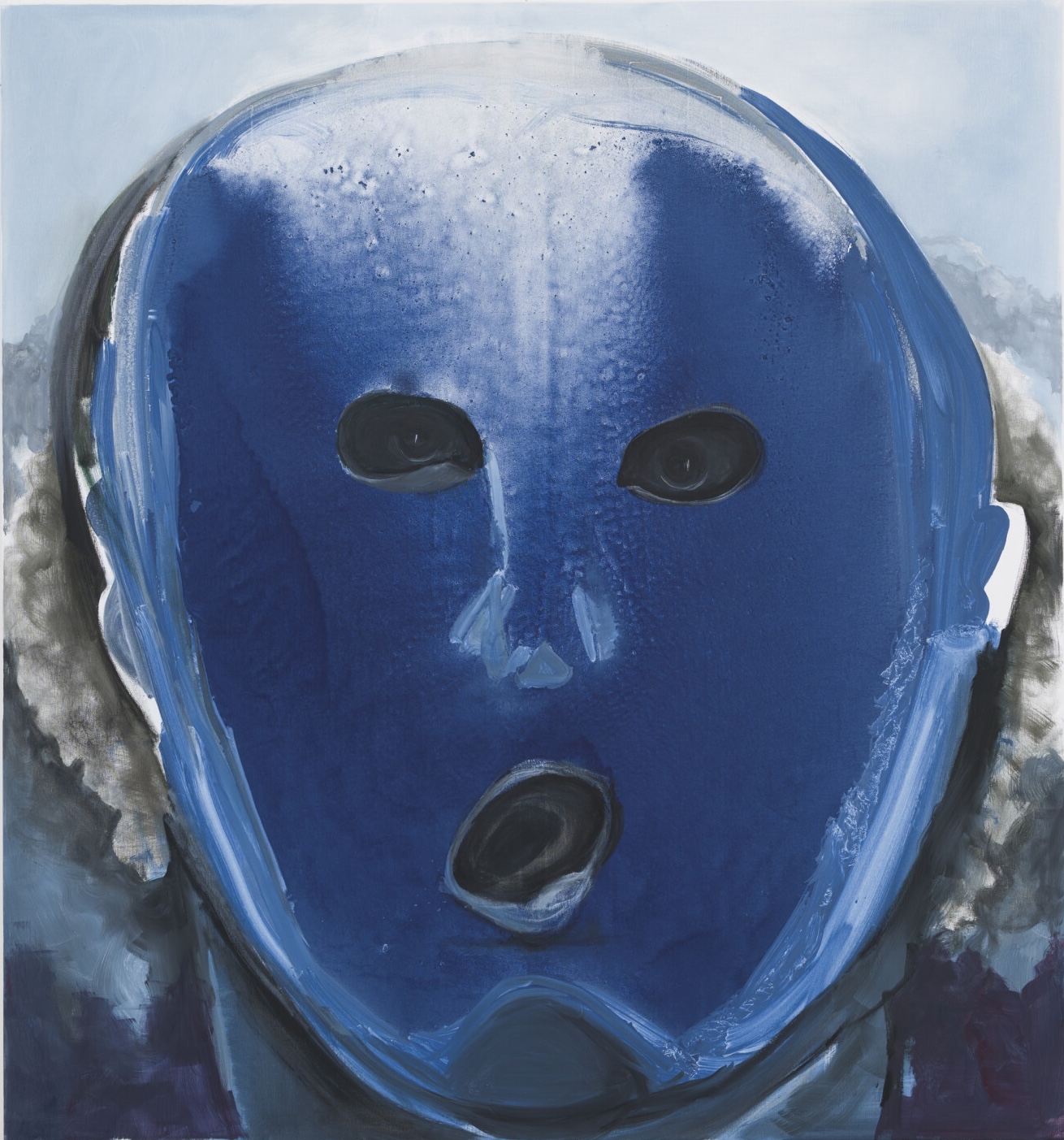

oil on canvas, 125 x 105 cm
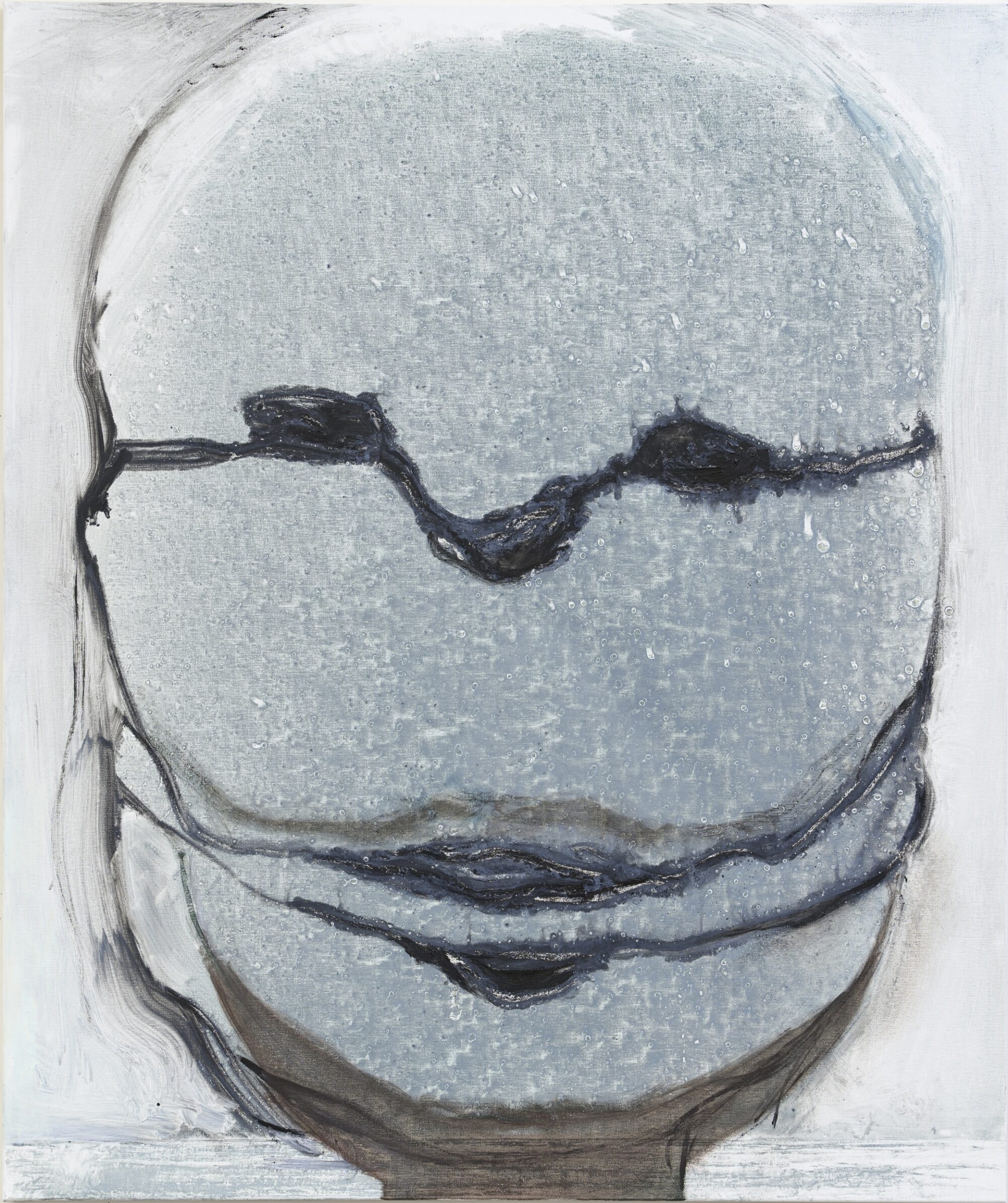
oil on canvas, 125 x 105 cm

oil on canvas, 125 x 105 cm
photography: Peter Cox, Eindhoven
The ‘limit-experience’ alluded to by the Liaisons is connected to Georges Bataille’s destabilising ideas about excess and transgression. Experiences that approach the limits of possible experience, such as extreme pain, ecstatic pleasure or mortal terror, may be part of life, but at the same time they are so different, so strange and out of the ordinary, that they can seriously disrupt our carefully coiffed self-image. Eroticism, the domain in which desire triumphs, may be a powerful sign of life, but according to the French philosopher, it also has a dark side, tied to what we are unwilling, afraid or forbidden to accept. For Bataille, erotic seduction borders on horror, and a kiss is an incitement to cannibalism. The extremity of desire, he writes, brings human beings into permanent conflict with themselves. Julia Kristeva builds on this idea. According to her, it is not so much the confrontation with the unknown that unnerves us, but the strangeness of what is most familiar to us: our body. We can never completely detach ourselves from that body, but neither do we ever fully coincide with it. The body makes us present in the outside world, exposing us to the gazes of strangers; we live constantly in the awareness that what feels most intimate to us also exists outside of ourselves. According to Kristeva, this confrontation with the stranger within has a disruptive effect on the image that everyone has of themselves.
What Kristeva called the ‘stranger within’ and the terrifying demons that, according to Bataille, we encounter within our instincts and urges, form the leitmotif in the nine paintings in Liaisons. The group silently raises the question of to what extent we are able to face the monstrous within ourselves. Those who are unable to deal with the strangeness of and within themselves, argues Kristeva, can easily fall prey to fear of the strange outside themselves. Such people react by excluding others, by dehumanising, demonising them. Declaring others to be monsters provides legitimacy for the use of violence against minorities, argues the Dutch philosopher Marli Huijers, and opens the door to xenophobia, racism and misogyny.
The image that humans create of themselves is the theme of Pareidolia and Makapansgat Pebble, two paintings from 2024 that immediately preceded the Liaisons. They refer to the atavistic need of humankind to find an image in its likeness, an urge that sets us apart from other species. Both paintings show the human face in its most elementary form. The title Pareidolia refers to the phenomenon of seeing, for example, faces in a random cloud formation, a form of illusory perception that may be related to the brain’s tendency to see connections and patterns, even when none are present. The subject of Makapansgat Pebble is a stone of around three million years old, found in a cave in South Africa. The site is named after Makapan, or Mokopane, the leader of the Ndebele, who starved to death with his people after taking refuge in the cave, when a Boer militia sealed them off from the outside world. Scientists hypothesise that hominids may have seen a face in the patterns on the stone’s surface, which is why they preserved the pebble. This would make the stone the earliest evidence of the capacity for symbolic thinking in human development. In her studio, Dumas keeps some old, somewhat childish-looking drawings of faces that she made with her five-year-old daughter in puddles of diluted ink, the Blobs (1993). As with the stone from Makapansgat, the human face appears in its most basic form in these watery stains.
Since the dawn of civilisation, the human image has taken many forms, not only in drawings, paintings and sculptures, but also in dolls, masks and ritual objects that have played a role in the worship of gods and ancestors, in initiation rites and funeral ceremonies. We have no idea who the vast majority of human figures passed down through the centuries represent or what exactly they mean. In his amazing visual atlas Mnemosyne, Aby Warburg attempted in the 1920s to chart the migration and the metamorphosis of symbolic figures that appear in all kinds of cultures throughout the centuries, sometimes under different names. The atlas contains almost a thousand pictures of works of art that express passion, suffering, insanity, devotion, redemption, tracing how such forms of expression, deeply embedded in our collective memory, have migrated from one culture into another, via Bilderfahrzeuge (‘image vehicles’, such as prints, paintings, tapestries) along the Wanderstrassen der Kultur, or ‘pathways of culture’.
Warburg’s intercultural and transhistorical reflection on artistic creativity, from the pharaohs in ancient Egypt to the Hopi in North America, is gaining traction in the museum world today. The Louvre, the British Museum and other prominent art museums are increasingly questioning the normative world image that they themselves once helped to institutionalise. The hierarchical distinction between art and craft, between magic and science, between the West and the rest of the world is being challenged. Laurence des Cars, who, as scientific director of Agence France-Muséums, led the development of the Louvre Abu Dhabi in the United Arab Emirates, advocates for the museum as a meeting place of cultures: she aims to initiate a dialogue between ancient civilisations and the modern era. In 2023, she said in an interview: ‘I am convinced that part of our task as a museum consists of applying nuance and complexity to the public debate and that we must resist our collective tendency to portray issues as simple.’ She believes that cultures that are far apart in time and place have more in common than is generally assumed. Within the context of the great common denominator of the human urge to create, expressions from diverse cultures become comparable.
The museum text introducing the Liaisons to the general public mentions ‘traces of a shared humanity […] that invite us to be in the presence of our humanity – in the museum’. There is something noble about this togetherness; it creates a sense of positivity and hope. Alle Menschen werden Brüder, something along those lines. The reality is less harmonious. Human nature is, after all, complex and full of inner contradictions. As Fernando Pessoa wrote in The Book of Disquiet: ‘In the vast colony of our being, there are people of many kinds, who think and feel in different ways.’ For the Portuguese poet, each individual is made up of different ‘selves’, a concept that he developed through his use of literary personas, which he called ‘heteronyms’, each made up of words that sound the same but mean something different. In Pessoa’s personas, there is an analogy with the nine heads of Liaisons, which may all have human physical features but refuse to be part of the same ‘family of man’, to paraphrase the title of a famous 1955 photographic exhibition. It is as if each of them is saying, ‘Count me out.’ In 1994, Marlene Dumas wrote, in ‘The Beginning of Love Stories and the End of Cultural Privacy’:
Identity
Don’t use the word identity in my presence.
For years a political system (in South Africa) insisted that what they’ve done, they’ve had to do to protect my identity.
Others
Yes, I am fascinated by the exotic, and the erotic and the barbaric and the heroic.
Yes. I am scared of Black people.
Yes I am scared of white people and dead people and sick people and especially those who say they like my work.
Not identifying with the group to which you belong: it is the choice of the misfit, the outlaw, the outsider, expressed with inimitable sarcasm and self-mockery by Groucho Marx: ‘I refuse to join any club that would have me as a member.’ It is also no coincidence that the title Liaisons brings to mind Les Liaisons dangereuses, the epistolary novel by Pierre Choderlos de Laclos, published in 1782 and filmed in 1988 as Dangerous Liaisons – a story about forbidden love, secret affairs and enthusiastic indulgence in transgressive behaviour among the French aristocracy at the time of the Ancien Régime.
In Dumas’s new studio, there is a newspaper clipping lying around that absolutely fascinates the artist. The article is about Mamoudou Gassama, an illegal Malian migrant in France, who became famous throughout the country in 2018, when he rescued a four-year-old boy from a burning flat by scaling the wall of the building. The ‘African Spider-Man’, as the press named him, was rewarded for his heroic act with a residence permit. And so the ‘alien’ became one of ‘us’. Dumas, herself a migrant, is often asked if she is a descendant of the famous French writer Alexandre Dumas, whose battle cry, ‘All for one, and one for all!’ from The Three Musketeers (1844) is more familiar than is the fact that he was Black. Dumas knows all about society’s fickle appreciation of the stranger. Following the naturalisation of Mamoudou Gassama, other undocumented immigrants claimed French citizenship, on the grounds that they, too, had performed good deeds. But that was out of sight of the cameras.
Liaisons by Marlene Dumas can be seen at the Louvre, Rue du Rivoli, Paris, from December 2025.
This text was previously published as: Dominic van den Boogerd, “Les Liaisons dangereuses. Marlene Dumas in the Louvre,” De Witte Raaf, no. 235 (2025): 18–19.
Copyright text: Dominic van den Boogerd